
 NON-VERBAL INTELLIGENCE TEST (NVT)
 Guidelines & Examples - Non Verbal Tests at ISSB
 After Reading these Notes:
- Live Practice Non Verbal Test- 40 Questions
- Non Verbal Test -Practice 2 (60 Questions)
- Verbal Intelligence Test at ISSB
 About Non-Verbal Intelligence Test?
A Quick Overview for ISSB Candidates
Think of the Non-Verbal Intelligence Test (NVT) as a pure visualization, seeing and responding without uttering a word. No words, no language, no memorized facts. Just shapes, patterns, and your brain.
It tests how fast and accurately you can:- Spot hidden patterns in visual sequences.
- Rotate or flip shapes mentally.
- Apply a rule from one pair of shapes to another.
- Solve visual puzzles under a tight time limit.
 Why Non Verbal Tests at ISSB ?
Officers need to read tactical maps, navigate in the air or at sea, and make quick decisions in complex, fast-changing situations. The NVT checks if you have the mental horsepower for that.
Procedure of Non Verbal Test
Two Ocassions— Initial Tests and at ISSB Centre
Stage 1 — Initial Screening (Before ISSB)
This happens at your Army, Navy, or Air Force recruitment centre (not at ISSB itself).- Held on the written test day at the recruitement center.
- Computer based test, held after the verbal intelligence test.
- Typical format: 64 questions in 30 minutes
- For some courses (like PMA Long Course or Technical Cadet): 92 questions in 40 minutes
- Passing this test is mandatory. — Failing in verbal intelligence test means, failing in initial tests.
Stage 2 — ISSB Centre Testing (Day 2)
If you pass Stage 1 and report to an ISSB centre (Gujranwala, Malir, Kohat, or Quetta):- It's either handwritten or computer based test.
- Non Verbal Test is conducted in a hall, supervised by a psychologist.
- Typical format: 50 questions in 40 minutes or 60 questions in 30 minutes.
- It helps the selectors to know your intelligence Level. — It feeds directly into your psychological profile.
- Verbal Interlligence test is cross-referenced with your Group Discussion, Command Task, and Interview performance.
 Think of it this way: Better performance in Non Verbal Test means higher intelligence level. It gets you respect of the selectors. A low score makes every other mistake look worse.
 Examples of Non-Verbal Intelligence Test
Understand the Structure of Non Verbal Tests at ISSB
The ISSB non-verbal test uses a number of question types. Once you recognise which type you're facing, solving it becomes much faster. These guidelines have examples of some of the types of non verbal intelligence tests.
Type 1 — Pattern Completion
(also called: Fill the Gap | Complete the Picture)
A design has a piece missing — like a puzzle with one piece cut out. Your job is to find the piece that fits perfectly.
What to look for:- See the image carefully.
- Line directions and flow across the grid.
- Shading and background patterns.
- Symmetry — does the design mirror itself?
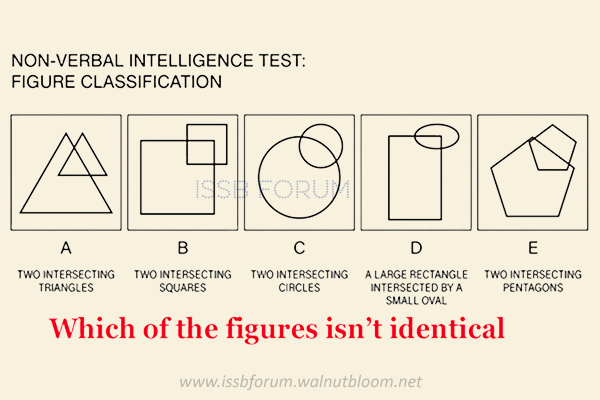
Type 2 — Figure Classification
(can also be called: Odd One Out | Which Doesn't Belong? | Find the Misfit)
Four or five shapes are shown. All but one share a common rule. Find the odd one out.
What to look for:- Look at every aspect of the images.
- Shape type (curved vs. straight edges).
- Number of sides or internal elements.
- Whether dots, lines, or markings follow a consistent rule
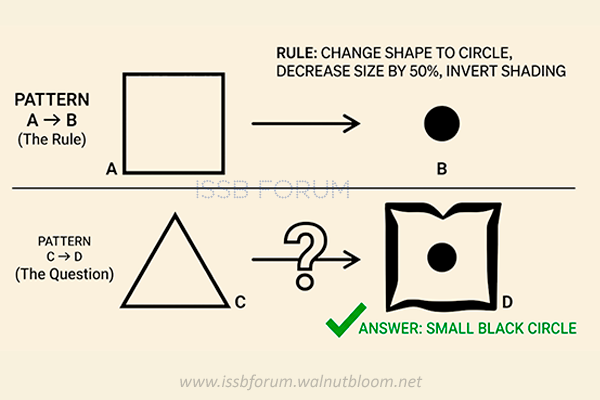
Type 3 — Analogies
(also called: Shape Relationships | What Goes With What? | If–Then Shapes)
A relationship is shown: Shape A changes into Shape B. Now apply that exact same change to Shape C to find Shape D.
What to look for:- Examine shapes keenly.
- Size changes (big → small).
- Shading changes (black → white or vice versa).
- Shape transformations.
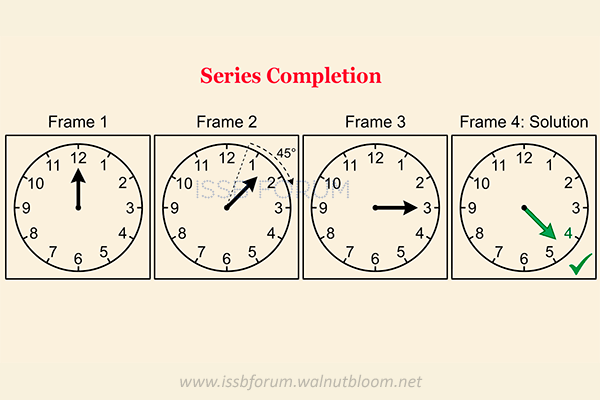
Type 4 — Series Completion
(also called: What Comes Next? | Continue the Sequence | Next in Line)
A sequence of 3–5 frames shows shapes changing step by step. You identify the rule and pick the next frame.
What to look for:- Rotation (by 45°, 90°, or 180° each step).
- Counting (lines, dots, or shaded sides increasing or decreasing).
- Movement (an element shifting position each frame).
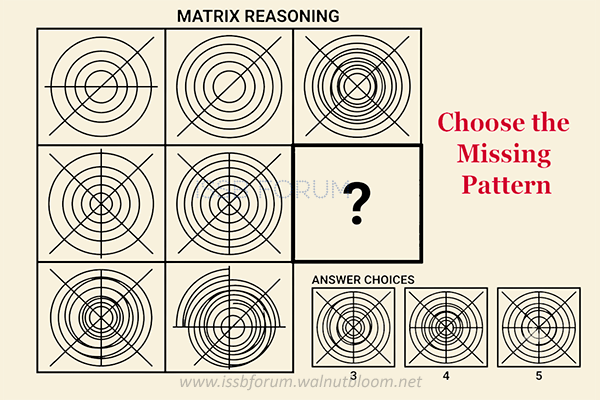
Type 5 — Matrix Reasoning
(also called: Grid Logic | 3×3 Puzzle | Row-and-Column Rules)
A 3×3 grid of shapes has one cell missing. Rules apply both across rows AND down columns — you must satisfy both to solve it.
What to look for:- What changes left-to-right across each row?
- What changes top-to-bottom down each column?
- The answer must follow both rules at once
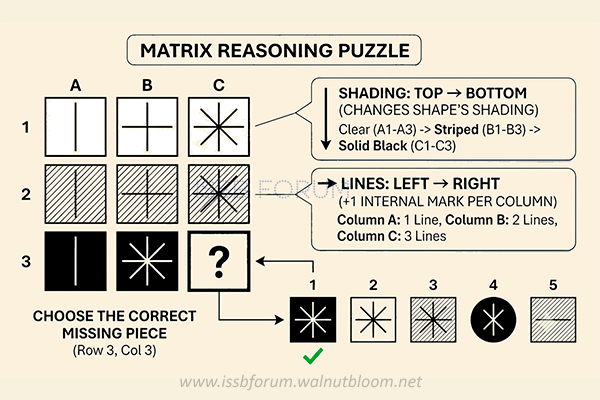
 Solved Sample Questions
Non Verbal Test Samples & Explanations
These questions match the style and difficulty of actual ISSB Non-Verbal tests.
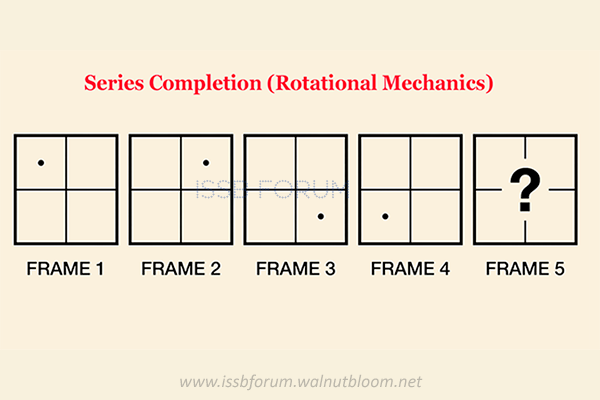
Rotating Dot (Series Completion)
The Pattern:
A box divided into 4 sections. A black dot moves one section clockwise each frame:
Top-Left → Top-Right → Bottom-Right → Bottom-Left → ?
Answer:
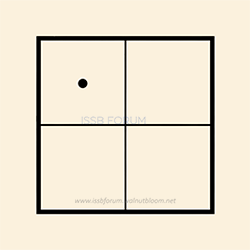
Top-Left — the dot returns to its starting position. It's a 4-step clockwise cycle, so Frame 5 = Frame 1.
The Different Shape (Odd One Out)
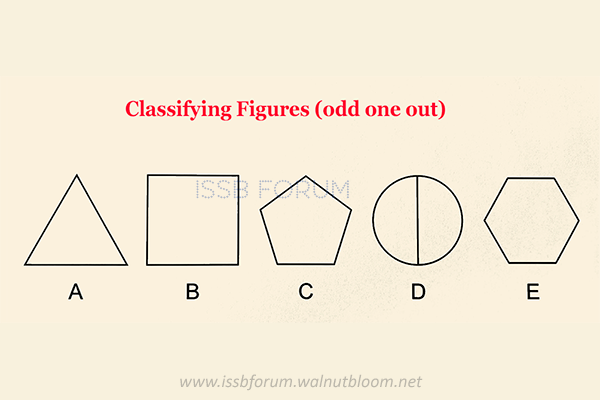
Answer: D — the circle with a line through it.
Key insight: A, B, C, and E are all straight-edged polygons (flat sides, sharp corners). Shape D introduces a curved boundary. That's the rule it breaks.
Size and Shading Flip (Analogy)
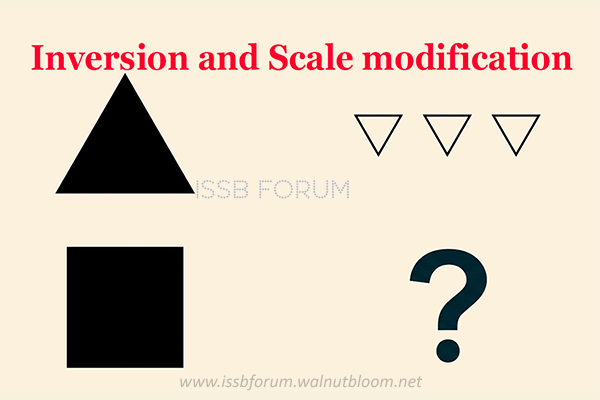
The rule shown: Large solid black triangle → 3 small white triangles pointing downward
The question: Large solid black square → ?
Answer: 4 small white squares.
Key insight: Two rules apply together — (1) the shape splits into as many small copies as it has sides (triangle = 3, square = 4), and (2) shading flips from solid black to white.
Overlapping Shapes (Matrix Reasoning)
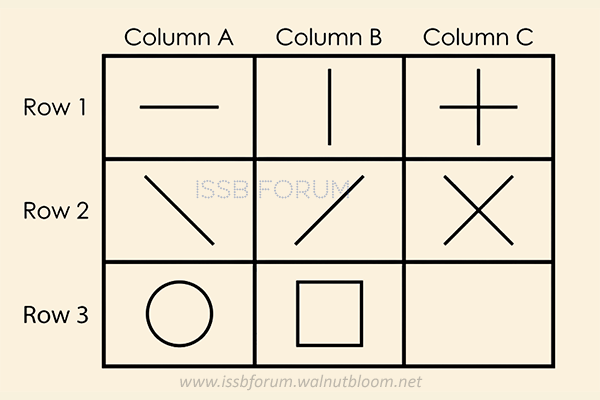
The rule: Across every row: Cell A + Cell B = Cell C (combine/overlap both shapes).
Answer:
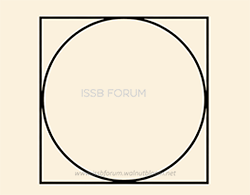
A square with a circle inside it — circle (Col A) + square (Col B) = square containing a circle.
Mirror Image (Pattern Completion)
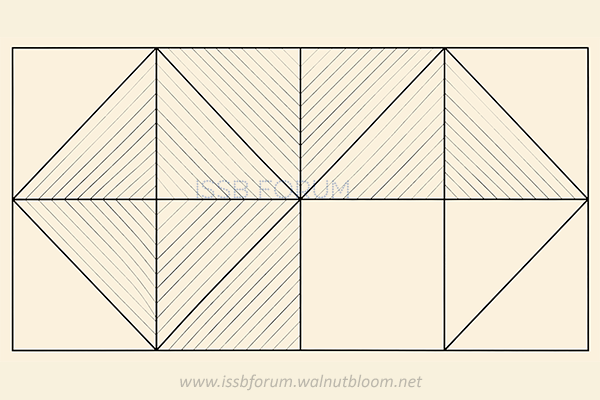
Answer:
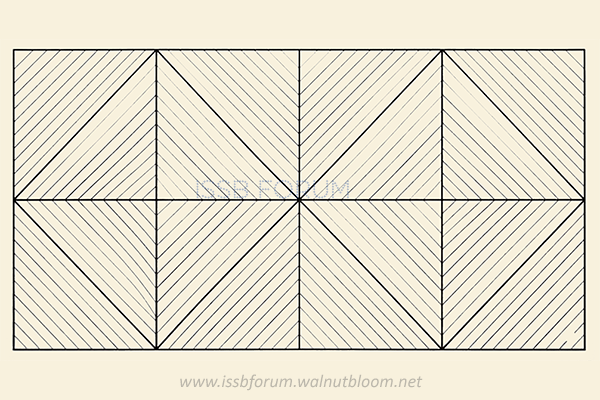
The pattern reflects itself across both the vertical and horizontal center lines. The missing section must mirror the top-right (flipped down) and also mirror the bottom-left (flipped right).
Growing Bold Sides (Series Completion)
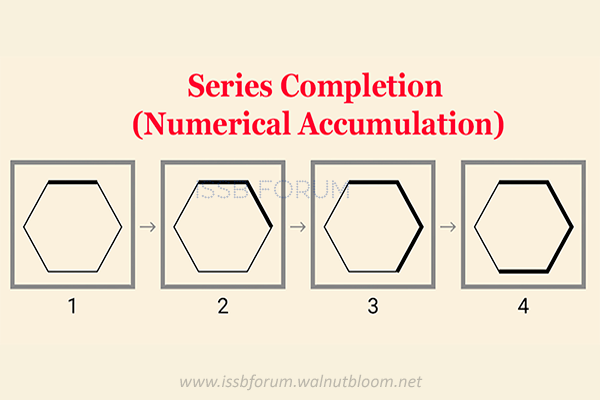
The pattern: One additional side of the hexagon becomes bold each step, moving clockwise. The sequence simply adds +1 each time.
Answer:
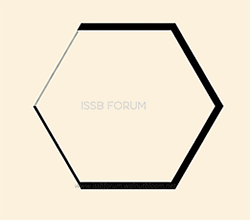
A hexagon with 5 bold sides — only 1 thin side remaining.
Mixed Shapes (Odd One Out)
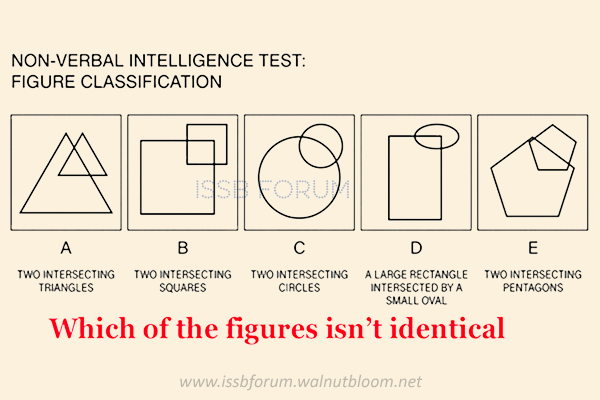
Answer: D — the rectangle and oval.
Key insight: In all other cases, the large shape and the small overlapping shape are the same type. Only D mixes a straight-sided rectangle with a curved oval. Rule broken = odd one out.
Outside to Inside (Analogy)
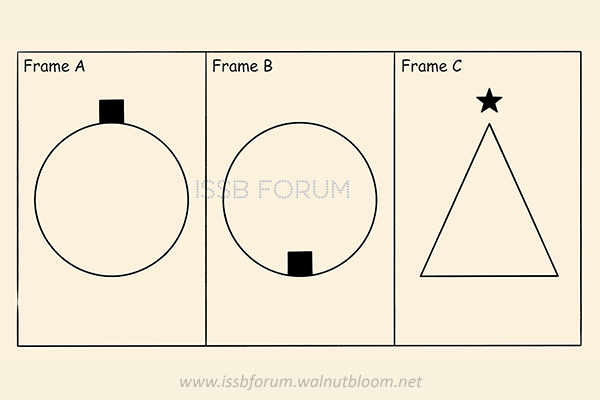
The rule shown: Small square sits on top of circle (outside) → same square moves to bottom of circle (inside).
The question: Star hovers above triangle tip (outside) → ?
Answer:
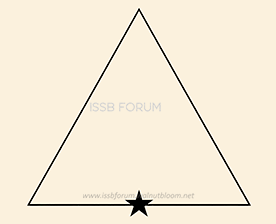
Triangle with the small star resting at the bottom inside it. The rule: move the small element from the top-outside to the bottom-inside of the main shape.
Counting Down (Matrix Reasoning)]
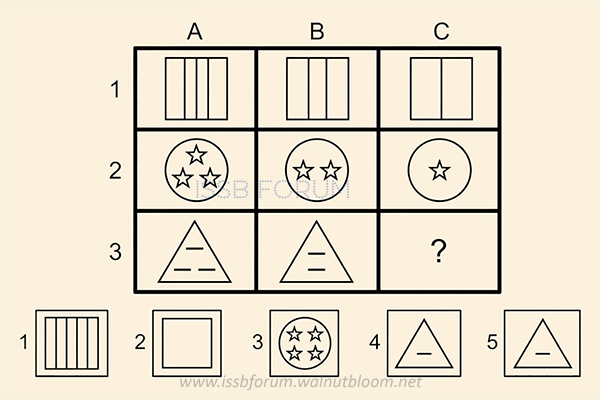
The rule: Moving left to right across each row: elements count down — 3, 2, 1.
Answer: A triangle with exactly 1 dash inside. The same countdown (3→2→1) applies to every row regardless of shape.
 Solving Non Verba Intelligence Test Faster
3 Practical Strategies for Test Day
Strategy 1 — Break It Down, One Variable at a Time
Don't stare at the whole image. Instead, isolate each element separately:- Count the lines or sides first
- Then track the shading (black, white, striped?)
- Then check rotation or movement
Strategy 2 — Eliminate Wrong Answers Immediately
The moment you find one rule (e.g., "the answer must be a black shape"), scan the options and cross off everything that isn't black. You reduce 5 choices to 2 or 3 instantly. This is called Process of Elimination and it's the fastest shortcut on any multiple-choice test.
Strategy 3 — The 20-Second Rule
If you're stuck and can't figure out a pattern within 20 seconds:- Make your best guess
- Move on immediately
- Come back if time allows
 FAQs — Non-Verbal Intelligence Test -ISSB
Frequently Asked Questions — NVT at ISSB
Is there negative marking?
No. There is no negative marking in either the initial screening or the ISSB center test.
Important: Leaving a question blank hurts just as much as a wrong answer — you get zero either way. In the final 60 seconds, if you have unanswered questions, quickly guess on all of them. Any chance of marks is better than zero.How Difficult are the questions?
- The Non Verbal Intelligence test are not designed to be difficult at all.
- A person with average intelligence shall be able to pass it.
- These are based on relative / comparative data and adjusted as per standards of the candidates.
- The real challenge isn't just the difficulty — it's the tight time pressure, speed and accuracy.
Can I improve my score by practicing?
Yes — definitely. When you practice hundreds of patterns, your brain starts to recognize common types instantly. A rotation question that once took you 30 seconds to decode starts taking just 3–5 seconds. You're not getting smarter — you're getting faster at pattern recognition, which is exactly what the test rewards.Do the Non Verbal Intelligence Test Need good English?
Mo — this is one of the main reasons the non-verbal test exists. Because it uses only pictures and shapes, a candidate from a remote village in Balochistan or Gilgit-Baltistan stands on exactly the same footing as a candidate from Lahore or Karachi. No language, no vocabulary, no textbook knowledge required.How much Non Verabl test affect my selection?
It has two layers of impact:
Stage 1 (Initial Screening):
If you don't clear the non verbal test, your test aren't held any further. selection ends immediately.
Also note that failing in intelligence tests is called as "screening out".
If a person get screened out twice at issb, he becomes permanently ineligible.
Stage 2 (ISSB Center): Your score becomes part of your psychological profile.
All selectors see your intelligence level and take a note of it.
So it helps to caste a good or bad impression.
 Practice Resources
For hands-on practice with actual non-verbal question types, use the live practice tests available on the forum:- FREE NON VERBAL LIVE TEST PRACTICE (60 Questions) — Test Your Intelligence Here
- NON VERBAL PRACTICE TEST 2 (40 Questions) — Visit ISSB Forum
Content prepared for ISSB Forum | issbforum.walnutbloom.net
 About Non-Verbal Intelligence Test?
 Why Non Verbal Tests at ISSB ?
 Think of it this way: Better performance in Non Verbal Test means higher intelligence level. It gets you respect of the selectors. A low score makes every other mistake look worse.
 Examples of Non-Verbal Intelligence Test
 Solved Sample Questions
 Solving Non Verba Intelligence Test Faster
 FAQs — Non-Verbal Intelligence Test -ISSB
 Practice Resources
